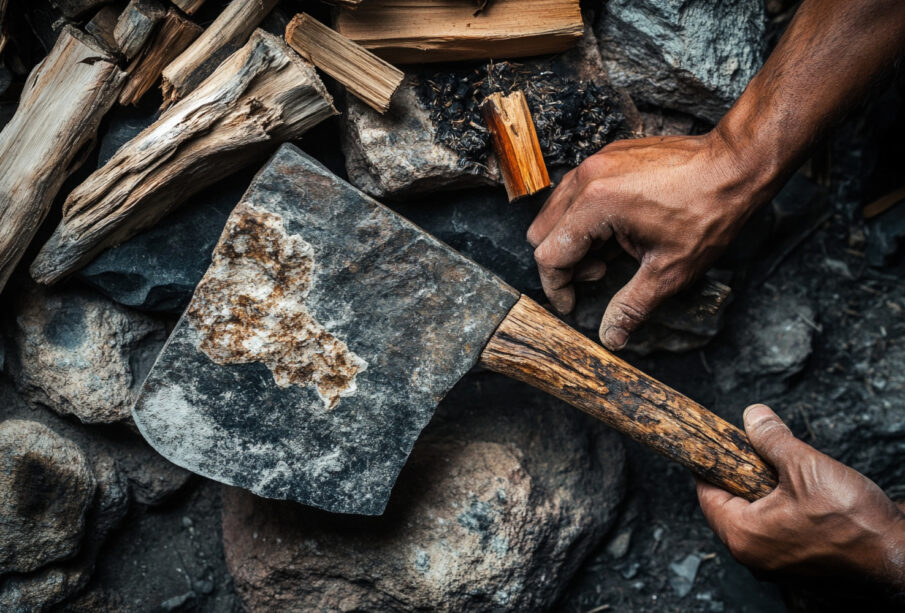
Human history is deeply connected to tools.
Long before cities, agriculture, or written language existed, early humans survived and thrived because they learned how to shape objects from nature into useful instruments. The evolution of early human tools not only transformed how our ancestors hunted and gathered food but also reshaped human intelligence, cooperation, and culture itself.
Understanding how tools developed helps us understand how humans became human.
The Beginning: Simple Stone Tools
The earliest known tools appeared more than 2.5 million years ago during the Stone Age. These first tools were extremely simple. Early humans selected stones and struck them together to create sharp edges that could cut meat, scrape animal skins, or break bones.
These tools were not carefully designed. Instead, they were practical solutions to immediate survival needs. A sharp rock could:
This early technology marked a major turning point. For the first time, humans were actively modifying their environment rather than simply adapting to it.
Oldowan Tools: Humanity’s First Technology
The earliest recognized tool tradition is often called the Oldowan industry. These tools consisted mainly of:
-
Choppers (stones with sharp edges)
-
Flakes broken off larger rocks
-
Hammerstones used for striking
Although simple, Oldowan tools required planning and understanding. Early humans had to choose the right type of stone and strike it at specific angles. This suggests growing cognitive ability and problem-solving skills.
Scientists believe toolmaking also encouraged learning through observation. Knowledge began passing from one generation to another, an early form of cultural transmission.
Acheulean Innovation: The Rise of Design
Around 1.7 million years ago, toolmaking became more sophisticated. Early humans began producing Acheulean handaxes, which were shaped on both sides to create symmetrical, teardrop-like tools.
This stage introduced something new: design intention.
Acheulean tools were:
Creating these tools required patience, skill, and mental visualization. Toolmakers had to imagine the final shape before starting, demonstrating advances in abstract thinking.
Many researchers believe this period reflects significant brain development and improved hand–eye coordination.
Tools and the Growth of Human Intelligence
Tool evolution did more than improve survival, it changed the human brain itself.
Using and making tools likely strengthened several cognitive abilities:
-
Planning ahead – Preparing tools before hunting or traveling
-
Memory – Remembering techniques and materials
-
Teaching and communication – Showing others how to make tools
-
Problem-solving – Adjusting designs for different tasks
As tool complexity increased, social learning became essential. Groups that shared knowledge survived better, encouraging cooperation and early forms of teaching.
Some scientists suggest that toolmaking and language development evolved together because both rely on sequencing actions and understanding cause and effect.
Expanding Materials: Beyond Stone
Over time, early humans expanded beyond stone tools. They began using:
-
Bone for needles and fishing tools
-
Wood for spears and digging sticks
-
Animal sinew and plant fibers for binding materials together
These composite tools combined multiple materials, showing advanced creativity and engineering thinking. Spears, for example, allowed humans to hunt from safer distances, increasing success rates and reducing risk.
Fire and Tool Advancement
The controlled use of fire further accelerated tool evolution. Fire allowed early humans to:
-
Harden wooden spear tips
-
Cook food, making nutrients easier to digest
-
Work in colder environments
-
Extend activity into nighttime hours
Cooking also reduced chewing time and improved nutrition, which may have supported brain growth, indirectly fueling further technological innovation.
Tools and Social Transformation
Tools reshaped human society in powerful ways:
-
Division of labor emerged as individuals specialized in hunting, gathering, or crafting.
-
Trade and sharing developed as tools became valuable resources.
-
Migration expanded, since better tools allowed humans to survive in new climates and landscapes.
Toolmaking became more than survival, it became culture. Styles and techniques varied between groups, creating early technological traditions.
The Cognitive Revolution of Tools
By the later Stone Age, tools included blades, needles, fishing hooks, and artistic carving instruments. These advances suggest humans were no longer focused solely on survival but also on creativity and symbolic expression.
The ability to create specialized tools shows a major cognitive leap:
-
Humans could imagine future needs.
-
They could innovate rather than simply copy.
-
Technology became cumulative, improving across generations.
This cumulative culture, where each generation builds on previous knowledge, is one of the defining features of humanity.
Why Early Tools Still Matter Today
Modern technology, from smartphones to spacecraft, traces its origins back to a sharpened stone held millions of years ago. Early tools represent the first step toward engineering, science, and innovation.
They reveal that human progress did not happen suddenly. Instead, it evolved gradually through curiosity, experimentation, and cooperation.
The story of early human tools is ultimately the story of human adaptation, a reminder that intelligence grows when humans solve problems creatively and share knowledge with others.
Conclusion
The evolution of early human tools transformed our ancestors from passive survivors into active creators of their environment. Beginning with simple stone flakes and advancing to carefully designed multi-material tools, each innovation strengthened human intelligence, social bonds, and adaptability.
These early inventions laid the foundation for civilization itself. Every modern technology reflects a long history of experimentation that began when early humans first realized a simple but powerful idea: nature could be shaped to serve human purpose.