
Historic African Cities That Shaped Civilization
Africa is often described as the cradle of humanity, but its contribution to civilization extends far beyond human origins.
For thousands of years, African cities served as centers of trade, scholarship, government, religion, craftsmanship, and cultural exchange.
Long before many modern cities emerged, African urban centers connected communities across deserts, rivers, coastlines, and trade routes. Their markets attracted merchants from distant regions, while their scholars, architects, artisans, and political leaders helped shape societies across the continent and beyond.
From ancient Egypt to the great trading cities of West Africa and the Swahili Coast, these historic cities reveal the depth and diversity of African civilization.
Ancient Memphis and the Foundations of Egyptian Civilization
Memphis was one of the most important cities of ancient Egypt. Located near the Nile Delta, it became a major political and religious center after the unification of Upper and Lower Egypt.
Its location gave it access to the Nile, which supported agriculture, transportation, trade, and communication. Memphis also became associated with powerful institutions and religious traditions that influenced Egyptian society for centuries.
The city’s history demonstrates how control of waterways and agricultural resources could support the development of complex urban civilization.
Thebes and the Power of Ancient Egypt
Thebes, located in modern-day Luxor, became another major center of ancient Egyptian civilization.
The city was particularly influential during periods when it served as the political capital of Egypt. Its temples, monuments, and royal burial sites reflect the wealth and organizational capabilities of ancient Egyptian society.
The remains of Karnak and Luxor provide evidence of the city’s religious and architectural importance. Across the Nile, the Valley of the Kings contains numerous royal tombs.
Thebes shows how cities could become centers of political authority, religion, architecture, and cultural memory.
Alexandria: A Meeting Point of Cultures
Founded by Alexander the Great in the fourth century BCE, Alexandria developed into one of the most influential cities of the ancient Mediterranean world.
Its position on Egypt’s Mediterranean coast made it an important center for trade and intellectual exchange. The city became famous for scholarship, science, literature, and philosophy.
The Library of Alexandria became one of the ancient world’s most famous institutions of learning, although the details surrounding its destruction remain debated by historians.
Alexandria’s history illustrates the importance of cities as places where different cultures and intellectual traditions interact.
Carthage and Mediterranean Trade
Carthage, located in present-day Tunisia, became a powerful commercial and political center in North Africa.
Founded by Phoenician settlers, Carthage developed an extensive trading network across the Mediterranean. Its merchants participated in the movement of agricultural products, metals, textiles, and other goods.
The city’s growing power eventually brought it into conflict with Rome during the Punic Wars.
Although Carthage was eventually destroyed by Rome in 146 BCE, its historical influence demonstrates the important role North African cities played in Mediterranean commerce and politics.
Timbuktu and the Intellectual Life of West Africa
Timbuktu became one of the most famous centers of learning and commerce in medieval West Africa.
Located near the Niger River and connected to trans-Saharan trade routes, the city benefited from the movement of gold, salt, books, and other goods.
Its scholars and educational institutions attracted students from different parts of the Islamic world. Manuscripts preserved in Timbuktu provide evidence of intellectual activity covering subjects such as religion, law, mathematics, astronomy, medicine, and literature.
The city’s history challenges the misconception that medieval Africa lacked major centers of scholarship.
Gao and the Songhai Empire
Gao, in present-day Mali, became an important political and commercial center of the Songhai Empire.
Its location along the Niger River helped connect agricultural communities with regional trade networks. Under the Songhai Empire, Gao became a significant center of administration and commerce.
The city also demonstrates the importance of the Niger River in the development of West African civilization. The river supported agriculture, transportation, fishing, and trade across a large region.
Jenne and the Growth of Urban Trade
Djenné, also known as Jenne, became an important commercial center in the inland Niger Delta.
Its location helped connect different trading communities across West Africa. Archaeological evidence shows that the area supported urban settlement and long-distance trade for many centuries.
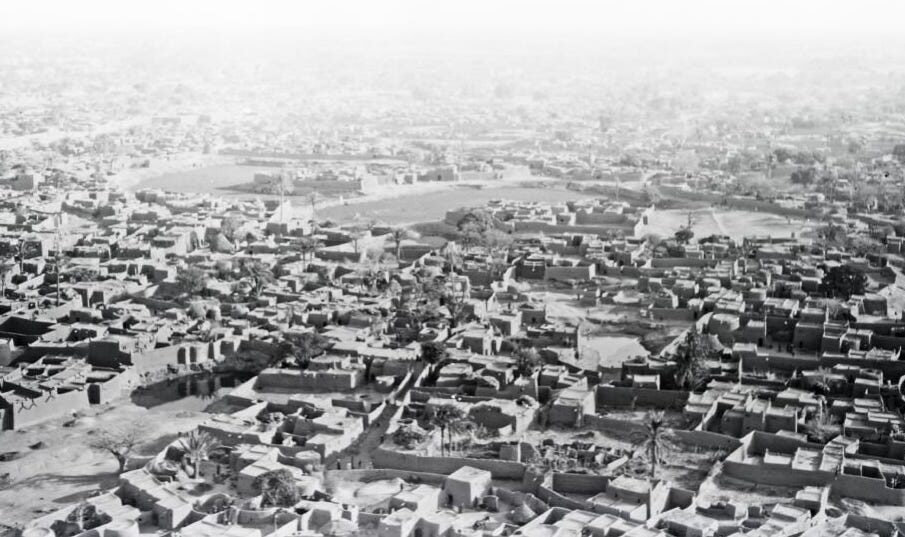
Djenné is particularly famous for its distinctive earthen architecture. The Great Mosque remains one of the most recognizable examples of traditional Sudano-Sahelian architecture.
The city provides an important example of how African societies developed urban environments adapted to local climates and available materials.
Benin City and West African Urban Development
Benin City, the historic capital of the Kingdom of Benin in present-day Nigeria, developed into a major political and artistic center.
The kingdom became famous for its sophisticated metalworking traditions, particularly the Benin Bronzes. Its craftsmen produced highly detailed sculptures and plaques that documented royal figures, ceremonies, and historical events.
The city was also known for its extensive earthworks and organized urban environment.
Benin City’s history demonstrates the sophistication of political organization, engineering, craftsmanship, and artistic production in precolonial West Africa.
Great Zimbabwe and Southern African Civilization
Great Zimbabwe, located in present-day Zimbabwe, was a major urban and political center between approximately the 11th and 15th centuries.
Its massive stone structures remain among the most impressive archaeological sites in Africa. The settlement was connected to regional and long-distance trade networks, with archaeological evidence indicating links to the Indian Ocean trading world.
Great Zimbabwe is particularly significant because its architecture was developed by African societies using local knowledge and resources.
Today, the site stands as an important reminder of the complexity of southern African societies before European colonial expansion.
Kilwa Kisiwani and the Swahili Coast
Kilwa Kisiwani, off the coast of modern Tanzania, became a wealthy Swahili trading city during the medieval period.
Its position along the Indian Ocean allowed merchants to participate in trade connecting East Africa with Arabia, Persia, India, and other regions.
Gold from the African interior was among the commodities moving through the region, alongside goods such as ceramics and textiles.
The ruins of Kilwa provide evidence of a cosmopolitan coastal society shaped by African, Arab, Persian, and Indian Ocean influences.
Meroë and the Kingdom of Kush
Meroë, located in present-day Sudan, was an important center of the Kingdom of Kush.
The city became known for its pyramids, ironworking, agriculture, and distinctive cultural traditions. The Kingdom of Kush maintained complex relationships with ancient Egypt and other neighboring societies.
Meroë’s history is particularly important because it highlights the development of powerful states south of Egypt and the diversity of ancient African civilizations along the Nile.
Why These Cities Still Matter
Historic African cities are more than archaeological sites. They provide lessons about urban planning, commerce, governance, technology, architecture, and cultural exchange.
Many of these cities developed around rivers, trade routes, natural resources, or strategic geographic locations. Their growth shows that African societies actively participated in regional and international economic networks long before the modern era.
Their histories also demonstrate that African civilization was never a single story. Different regions developed distinct political systems, architectural styles, economic networks, religious traditions, and artistic cultures.
Preserving Africa’s Urban Heritage
Rapid urbanization creates both opportunities and challenges for historical preservation.
Modern development can sometimes place archaeological sites, historic buildings, traditional neighborhoods, and cultural landscapes under pressure. Preserving these places requires cooperation between governments, historians, archaeologists, local communities, tourism organizations, and educational institutions.
Digital documentation, responsible tourism, museum programs, heritage education, and community-led conservation can help younger generations understand the importance of these sites.
Preservation can also support local economies by creating opportunities in tourism, crafts, research, hospitality, and cultural education.
Conclusion
From Memphis and Thebes to Timbuktu, Benin City, Great Zimbabwe, and Kilwa Kisiwani, historic African cities played important roles in shaping political, economic, intellectual, and cultural development.
Their stories reveal societies that built complex cities, developed sophisticated trade networks, produced remarkable art and architecture, and participated in long-distance exchanges.
Understanding these cities provides a broader view of African history and reminds us that the continent’s urban heritage stretches back thousands of years. Protecting and studying that heritage can help ensure that future generations appreciate the many civilizations that contributed to Africa’s rich historical identity.




Leave a reply




Africa’s Source for Breaking News | Entertainments | Health | Finance | Sports | Lifestyle and Business News.


