
The Best Nigerian Games That Capture Life in the City
Lagos Life Games
Lagos Life Games: The Best Nigerian Games That Capture Life in the City
Lagos is not a city you simply live in. It is a city you learn to navigate.
Every day comes with its own challenges. Traffic tests your patience. Danfo buses test your bargaining skills. Markets test your ability to spot a good deal. Neighbours know more about your business than you expect, while social media somehow turns ordinary Lagos experiences into entertainment.
For many Nigerians, these experiences are so familiar that they have become a kind of unofficial game. You learn the rules, develop strategies and hope you make it through the day without losing your money, your phone or your patience.
Interestingly, Nigerian game developers and creators have started turning these everyday experiences into games. Some are mobile games. Others are board games, party games or digital experiences. Together, they show that Nigerian life can be funny, competitive and surprisingly entertaining.
Here are some of the best Nigerian games and game concepts that capture the spirit of Lagos life.
1. Danfo Driving Games
Few things represent Lagos more than the yellow danfo bus.
A typical danfo journey involves traffic, impatient passengers, aggressive drivers, conductors shouting destinations and the constant search for change. It is therefore no surprise that danfo-inspired games have become an entertaining way to recreate Lagos transportation.
In a danfo driving game, players can take on the role of a driver navigating Lagos roads. The objective may be to pick up passengers, avoid accidents, beat traffic and make enough money before the end of the day.
The fun comes from the chaos.
One moment you are moving smoothly. The next, traffic has completely stopped. A passenger wants to get down in the middle of the road. Another person is running after the bus. Meanwhile, the fuel gauge is dropping.
It is a digital version of an experience millions of Lagos residents understand immediately.
2. Lagos Traffic Games
If Lagos had an official sport, traffic management might be a strong contender. The city’s traffic has inspired jokes, memes, complaints and countless conversations. It has also created an opportunity for game designers.
A Lagos traffic game could put players behind the wheel and challenge them to reach different parts of the city within a limited amount of time.
Players might have to choose between Ikorodu Road, Third Mainland Bridge, Lekki-Epe Expressway or alternative routes through smaller streets.
The challenge would not simply be driving. It would involve decision-making.
Do you stay on the main road and hope traffic clears? Do you take a shortcut? Is the shortcut actually faster? Should you leave now or wait until later?
These are questions Lagos drivers answer every day.
3. Nigerian Monopoly-Style Games
Traditional Monopoly is built around buying properties, collecting rent and building wealth. Nigerian versions can make the experience feel much closer to home.
Imagine replacing famous international locations with Lagos neighbourhoods.
Players could buy properties in Ikeja, Yaba, Surulere, Lekki, Victoria Island, Ajah or Lagos Island. Instead of generic transportation spaces, players could encounter danfos, ride-hailing services and bus terminals.
The game could also include uniquely Nigerian situations.
You might receive money for a successful business deal but lose money because your generator needs repairs. You might collect rent from tenants but then face a sudden increase in operating costs.
This type of game turns familiar economic realities into entertainment while encouraging players to think about money, property and business.
4. Naija Whot!
Few games are more familiar in Nigerian homes than Whot!
Although Whot! is not originally Nigerian, Nigerians have embraced it so strongly that it has become part of everyday social culture.
A typical game can quickly become competitive.
Someone plays a card and everyone suddenly becomes serious. Players watch each other’s moves, remember cards that have already appeared and look for opportunities to change the direction of the game.
Whot! captures something important about Nigerian social life: Nigerians enjoy competition.
Whether it is football, business, arguments, family games or parties, there is often someone determined to win.
The game also works almost anywhere. At home, in school, during trips or at social gatherings, Whot! requires little equipment and can keep people entertained for hours.
5. Nigerian Trivia and “How Well Do You Know Lagos?” Games
Lagos has a deep cultural history, making trivia games another excellent way to capture city life.
A Lagos-themed trivia game could ask questions about neighbourhoods, markets, food, slang, music, transportation and popular landmarks.
For example:
- Which market is famous for large-scale food trading?
- What does a particular Lagos slang expression mean?
- Which road connects two major parts of the city?
- Which neighbourhood is known for nightlife?
- What is the difference between a danfo and a BRT bus?
These questions may appear simple, but they can quickly expose who actually knows Lagos.
Trivia games also provide an opportunity to introduce younger Nigerians to the city’s history and culture.
6. Nigerian Business and Hustle Games
Lagos is one of Africa’s major commercial centres, and the city’s hustle culture is almost impossible to separate from everyday life.
A Nigerian business game could allow players to start with a small amount of money and build a business.
Perhaps you begin by selling snacks. You make enough profit to open a small shop. Eventually, you expand into distribution, logistics or online retail.
But success would not be guaranteed.
Players would have to deal with changing prices, customer complaints, transportation costs, competition and unexpected expenses.
That reflects the reality of many Lagos entrepreneurs.
Running a small business in Lagos often requires creativity, patience and the ability to adapt quickly.
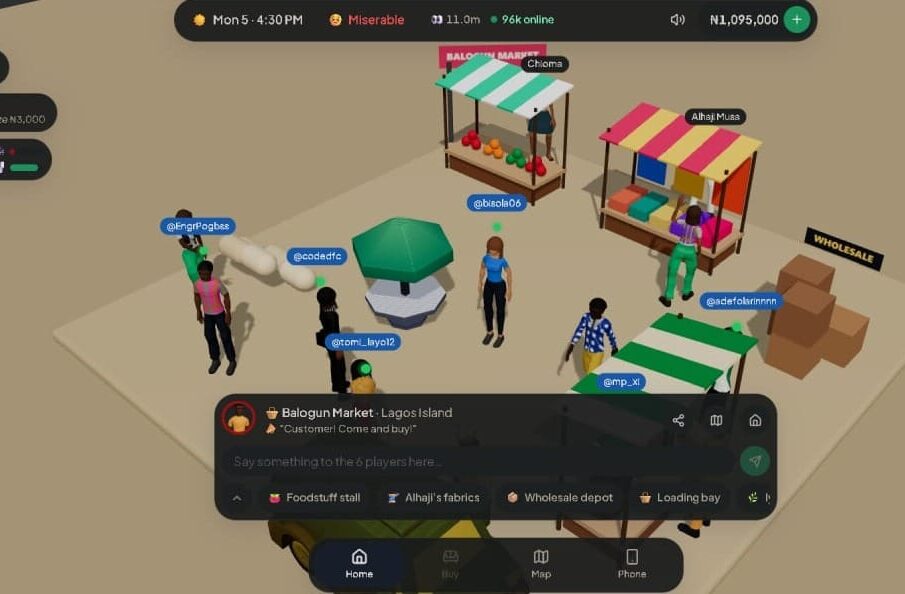
7. “Market Wahala” Games
Markets are another major part of Lagos life.
Places such as Balogun, Computer Village and Mile 12 are filled with activity. There are traders, customers, wholesalers, retailers, transporters and countless negotiations.
A market-themed game could turn bargaining into its central mechanic.
Players could receive a shopping list and a limited budget. Their job would be to find products at the best prices.
The challenge would involve comparing sellers, negotiating prices and avoiding unnecessary purchases.
Someone who spends all their money too early could lose the game.
It would be entertaining, but it would also teach a useful lesson: knowing what to buy is only half the battle. Knowing where and how to buy it matters too.
8. Lagos Party and Social Games
Lagos social life provides endless material for party games.
Imagine a game based on popular Nigerian expressions, music, celebrities, food and social situations.
Players could act out familiar Lagos scenarios, guess Nigerian songs from short clues or explain slang without using certain words.
The appeal would come from recognition.
Everyone has experienced that friend who arrives late to an event, the relative who asks uncomfortable questions or the person who turns every gathering into a dance competition.
These games work because they transform ordinary Nigerian experiences into shared jokes.
9. “Survive Lagos” Adventure Games
Perhaps the most ambitious idea would be a full Lagos survival game. Players could create characters and navigate different parts of the city while managing money, time, food, transportation and work.
One day might involve finding an affordable apartment. Another could involve getting to work during heavy traffic. Another might require completing several errands before sunset.
Players would have to make choices.
Should you spend more on transport to save time or take a cheaper route and risk arriving late? Should you save your money or spend it on something that improves your character’s abilities?
Such a game could combine entertainment with a surprisingly accurate representation of urban Nigerian life.
Why Lagos Makes Such Good Game Material
The reason Lagos works so well as a setting is simple: the city is unpredictable.
Everyday life involves constant decisions.
You negotiate prices, plan around traffic, manage limited time, interact with strangers and solve problems with whatever resources are available.
That creates natural game mechanics.
Lagos also has a strong sense of humour. Residents often turn frustrating situations into jokes. A traffic delay becomes a story. A market negotiation becomes entertainment. A strange encounter becomes something to tell friends.
Games capture this ability to find fun in ordinary situations.
The Future of Nigerian Games
Nigeria’s gaming industry has room to grow far beyond foreign characters and international settings.
There is an opportunity to create games based on Nigerian cities, cultures, languages and everyday experiences.
Imagine games built around Lagos nightlife, Kano markets, Abuja politics, Enugu culture or Port Harcourt’s oil economy. Each location could offer its own characters, challenges and stories.
For Nigerian developers, this is more than entertainment. It is also storytelling.
Games can preserve slang, traditions, architecture, humour and social experiences in a form younger generations can interact with.
Final Thoughts
Lagos can be exhausting, expensive and chaotic. Yet it is also energetic, creative and full of stories. That combination makes it perfect for gaming.
From danfo driving and traffic challenges to market bargaining, business hustling, trivia and social games, Nigerian life already contains many of the elements that make games enjoyable.
Perhaps the next great Nigerian game will not need an imaginary world.
It may simply ask players to survive a Monday morning in Lagos.
And honestly, that might be challenging enough.



Leave a reply





Africa’s Source for Breaking News | Entertainments | Health | Finance | Sports | Lifestyle and Business News.


