
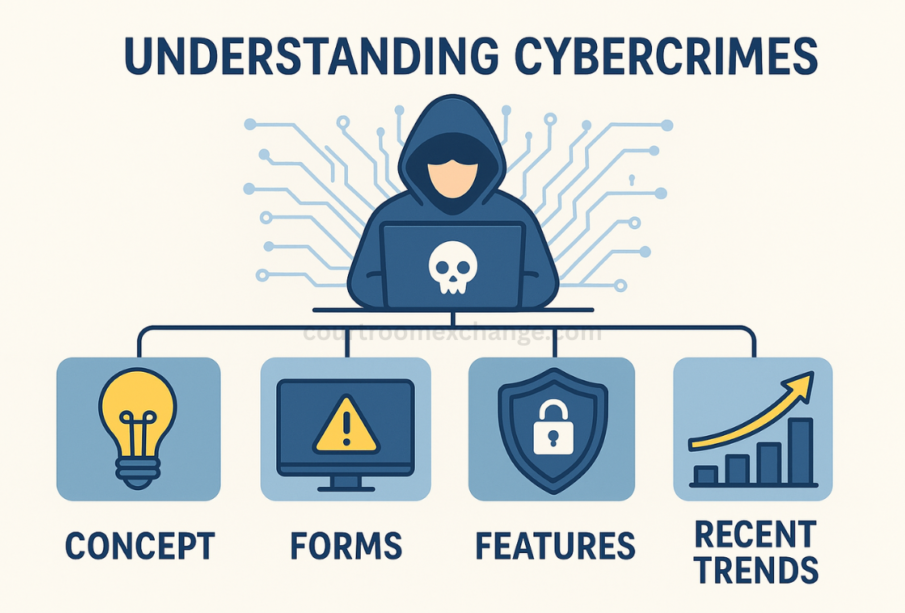
Understanding Cybercrime Trends
The digital world has transformed how people communicate, work, shop, manage money, and access services.
However, this rapid digital growth has also created new opportunities for criminals. Cybercrime is no longer limited to sophisticated hacking attempts against large corporations. Today, individuals, small businesses, financial institutions, governments, and online communities can all become targets.
Across Africa, the changing digital landscape has contributed to the growth of online scams, phishing, ransomware, business email compromise, digital extortion, and other forms of cybercrime. INTERPOL’s 2025 assessment identified online scams, ransomware, business email compromise, and digital sextortion among the continent’s major cyberthreats.
Understanding current cybercrime trends is therefore important for anyone who uses the internet.
What Is Cybercrime?
Cybercrime refers to illegal activities that involve computers, mobile devices, networks, or the internet. Criminals may use technology to steal money, obtain personal information, disrupt systems, impersonate others, or blackmail victims.
Some attacks target individuals directly. Others focus on businesses, banks, government agencies, hospitals, or other institutions.
The methods also continue to change. Criminals increasingly combine technical tools with psychological manipulation. Instead of simply trying to break into a system, attackers may persuade someone to voluntarily reveal a password, transfer money, or click on a malicious link.
Major Cybercrime Trends to Watch
1. Online Scams Are Becoming More Sophisticated
Online scams remain one of the most common cybercrime threats in Africa. Phishing messages, fake investment opportunities, romance scams, fraudulent promotions, and impersonation schemes can appear through email, websites, social media, and messaging platforms.
Scammers often create a sense of urgency. A message may claim that an account will be blocked, a payment has failed, or a valuable opportunity will disappear soon.
This pressure encourages victims to act before verifying the information.
2. Artificial Intelligence Is Changing Cybercrime
Artificial intelligence has become an important part of the cybercrime landscape.
Criminals can use AI to create convincing messages, automate social engineering, imitate communication styles, and produce synthetic images or audio. INTERPOL reported in August 2026 that AI was linked to 55% of reported cybercrime in Africa.
AI can also make impersonation scams more believable. A fraudulent message may contain better grammar, personalized information, or communication that closely resembles that of a genuine person or organization.
As a result, people can no longer rely only on obvious spelling mistakes or poorly written messages to identify scams.
3. Business Email Compromise Remains a Serious Threat
Business email compromise, commonly known as BEC, involves criminals manipulating email communication to deceive businesses or employees.
An attacker may impersonate an executive, supplier, client, or business partner. The goal could be to redirect a payment, obtain confidential information, or gain access to company systems.
This type of crime can be particularly damaging because the victim may believe the request comes from someone they already know.
Businesses should therefore establish clear procedures for verifying unusual payment requests, especially when bank details or payment instructions suddenly change.
4. Ransomware Continues to Threaten Organizations
Ransomware is another major cybercrime trend. In a ransomware attack, criminals may prevent an organization from accessing its systems or data and then demand payment.
Hospitals, government institutions, businesses, schools, and other organizations can be attractive targets because disrupting their operations can create significant pressure to respond quickly.
INTERPOL has identified ransomware as one of the prominent cyberthreats affecting African organizations, while international threat assessments continue to rank it among the most impactful cyber threats.
Regular backups, software updates, access controls, and employee awareness can reduce exposure.
5. Mobile and Social Media Fraud Is Growing
Africa’s expanding use of smartphones, mobile money, social media, and digital financial services has created enormous economic opportunities. At the same time, criminals are exploiting these platforms.
INTERPOL’s 2025 assessment highlighted mobile wallet fraud, social engineering, romance scams, and other digital schemes across African regions.
A criminal may impersonate a bank representative, friend, family member, employer, or online seller. They might then request an urgent transfer or attempt to obtain a verification code.
Users should treat unexpected requests for passwords, PINs, one-time passwords, and financial information with extreme caution.
The Rise of Digital Extortion
Digital extortion involves threatening victims with the release of sensitive information, images, or other material unless they provide money or comply with demands.
Sextortion is one example. Criminals may obtain intimate images through deception, coercion, hacking, or fabricated content and then threaten to distribute them.
AI-generated images and other synthetic media can make this threat even more complicated. INTERPOL has reported growing concerns around AI-assisted sextortion and harassment in Africa.
Victims should avoid negotiating with criminals and should consider reporting serious threats to the appropriate platform or law-enforcement authority.
Why Cybercrime Is Difficult to Stop
Cybercrime rarely respects national borders. A victim may live in Nigeria, the criminal may operate from another country, and the stolen information or infrastructure may be hosted somewhere else.
This makes investigation and prosecution complicated.
INTERPOL’s 2025 assessment found that many African countries face challenges involving specialized training, digital forensic resources, reporting systems, and international cooperation.
However, regional cooperation is improving. INTERPOL’s African Joint Operation against Cybercrime brings countries and partners together to strengthen prevention, investigation, and disruption efforts.
How Individuals Can Protect Themselves
Understanding cybercrime trends is useful, but awareness should lead to practical action.
Consider these basic habits:
- Use strong, unique passwords for important accounts.
- Enable multi-factor authentication where available.
- Avoid clicking unexpected links or downloading suspicious attachments.
- Verify financial requests through a separate communication channel.
- Never share passwords, PINs, or one-time verification codes.
- Keep phones, computers, browsers, and applications updated.
- Be careful about the personal information shared publicly online.
- Verify investment opportunities before sending money.
- Back up important files regularly.
- Report suspicious activity instead of ignoring it.
Most importantly, pause before responding to unexpected messages. A few seconds of verification can prevent a significant financial or personal loss.
Cybersecurity Is Everyone’s Responsibility
Cybersecurity is sometimes treated as the responsibility of IT departments or government agencies. However, ordinary users play an equally important role.
An employee who verifies an unusual payment request can prevent business fraud. A parent who teaches a child about suspicious links can reduce online risks. A small business owner who enables multi-factor authentication can make an account harder to compromise.
Therefore, cybersecurity awareness should become part of everyday digital behaviour.
Conclusion
Cybercrime is constantly changing. Traditional phishing has evolved into highly personalized social engineering, while ransomware, business email compromise, mobile fraud, digital extortion, and AI-assisted scams continue to create new challenges.
Africa’s expanding digital economy makes cybersecurity awareness increasingly important. Recent INTERPOL findings show that AI is accelerating the scale and sophistication of cybercrime across the continent.
The good news is that individuals and organizations can take meaningful steps to reduce their risks. Staying informed, verifying suspicious requests, protecting accounts, updating devices, and reporting incidents can make a significant difference.
In the digital age, understanding cybercrime is no longer just a technical concern. It is an essential part of staying safe online.




Leave a reply





Africa’s Source for Breaking News | Entertainments | Health | Finance | Sports | Lifestyle and Business News.


